一。新闻简报。
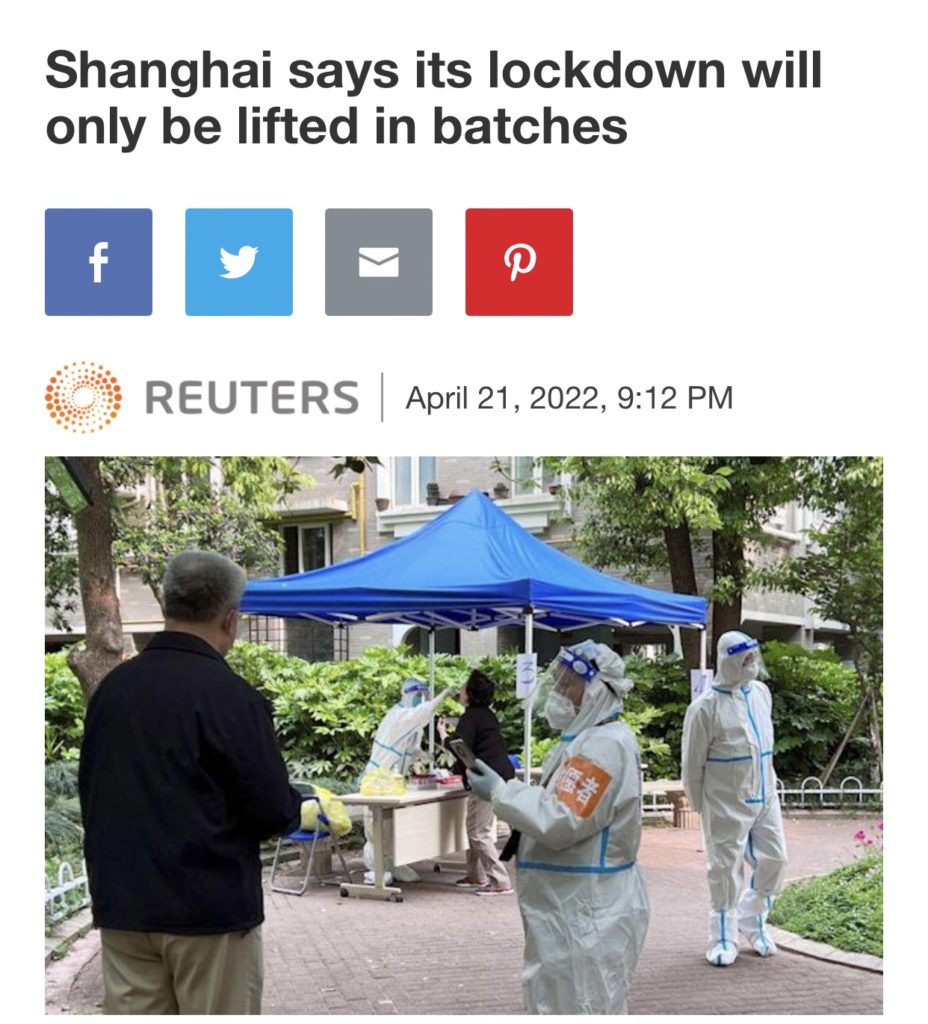
1。上海(路透社)——上海周五表示,一旦隔离区外的病毒传播被遏制,将分批解除封锁。
2。中国和所罗门群岛都证实他们签署了一项安全协议,该协议引发了人们对中国在太平洋地区影响力上升的担忧。

3。美国陆军计划取得一种新型的便携式导弹,士兵可以用它来击落飞机。 为了取代陈旧的毒刺防空武器,陆军于 3 月 28 日提出了信息请求,并希望该武器在2027 年之前投入生产。

4。(CNN)——乌克兰总统泽连斯基宣布,美国国务卿安东尼·布林肯和美国国防部长劳埃德·奥斯汀将于周日访问基辅。

5。东京(美联社)——日本在周五发布的最新版外交报告中将与莫斯科有争议的四个岛屿描述为“被俄罗斯非法占领”,使用比其他最新版本更强烈的语言来描述领土变动,并强调了在俄罗斯入侵乌克兰期间两国的冷淡关系。

6。上海当局表示,随着上海疫情继续激增,他们将加强封锁措施的执行。新措施包括放置电子门警报,以防止感染者离开,以及疏散人们以对房屋进行消毒。

7。卫生署香港卫生防护中心(CHP)昨天宣布,内地新增一宗人类感染甲型禽流感(H5N6)病例,这是2022年以来的第13例。该病例涉及四川省德阳市一名56岁男性,发病前曾接触过活家禽。 他于 3 月 31 日出现症状,并于 4 月 4 日入院接受治疗。他的情况严重。

8。4 月 22 日发表在《柳叶刀呼吸医学》杂志上的一项研究表明,辉瑞 COVID-19 疫苗的加强剂量在最初几个月内提供了大约 80% 至 90% 的强保护,以防止因三角洲和 omicron 变体。 然而,对于 omicron,这种保护会随着时间的推移而减弱——即使在第三剂之后也是如此。

9。专家说,中国严格的 COVID-19 封锁将加剧全球供应链的困境,并在未来几个月加剧通胀。

10。法国将于 4 月 24 日星期日进行第二轮也是最后一轮总统选举的投票。 虽然伊曼纽尔·马克龙似乎有可能获得第二个任期,但其竞争对手、极右翼国家拉力党的玛丽娜·勒庞却一直紧随其后。 在竞选活动的某一时刻,她仅落后总统 3 个百分点。

11。英国国会议员获悉,据信,私营军事公司瓦格纳集团的近 3,000 名成员在乌克兰战场上为俄罗斯而战时丧生。

12。世界卫生组织周五表示,它“强烈推荐”辉瑞公司的 Covid-19 抗病毒药 Paxlovid ,用于仍有高住院风险的轻度疾病患者。

13。上海居民告诉自由亚洲电台,在影响约 2600 万人的严酷 COVID-19 封锁期间,神秘的栅栏,在一夜之间出现,封锁了上海的城市通道。

14。图宾根大学医院的一组德国研究人员开发了一种名为 CoVac-1 的新型 COVID 疫苗,其在免疫功能低下的白血病和淋巴瘤等癌症患者中产生了强烈的免疫反应。

15。孟加拉国达卡(美联社)——周五,数千名伊斯兰组织成员在孟加拉国首都集会,抗议瑞典最近发生的暴力事件,其中涉及一个反穆斯林极右翼组织,以及耶路撒冷阿克萨清真寺发生的新冲突。

二.美国疫情
昨日美国新增新冠患者_人
总确诊人数为80,971,925人。
新增死亡人数1,005人。
总死亡 991,231人。
康州新增新冠感染1,150人,新增死亡8人。
纽约州新增新冠确诊人数8,475人。新增死亡人数10人。
新泽西州昨天新增病例为2,870人。新增死亡为8人。
马萨诸塞州新增新冠患者为2,473人, 死亡3人。
马里兰州昨日新增新冠患者1,015人。新增死亡人数为4人。
三.世界疫情
1) 亚洲疫情:
昨日印度新增新冠患者2,527人;
日本新增42,898人;
印尼新增651人;
菲律宾新增229人;
孟加拉新增21人。
土耳其新增2,898人。
台湾昨日新增_.
韩国昨日新增_人,
中国新增19,027人。
2)非洲疫情:
南非昨日新增新冠患者24,629人。
埃塞俄比亚新增16人。
摩洛哥新增47人。
3)拉美疫情:
巴西昨日新增新冠患者8,068人.
哥伦比亚新增283人。
阿根廷新增_人。
智利新增2,949人。
墨西哥新增_人。
4)欧洲疫情
俄罗斯昨日新增新冠患者8,843人。
德国新增135,079人。
法国新增88,520人。
英国新增23,932人。
意大利新增73,744人。
西班牙新增_人。
5)全球新冠总感染人数为509,116,073人。
总死亡人数为6,216,725人。
以下是社区广告:


打赏或捐助方式如下:
1)Venmo 电话号码确认:7414

2). Zelle 或 Paypal (支付宝)
Guzhendi@yahoo.com
衷心感谢大家的支持!
顾震帝 2022年4月24日。
my explanation https://web-foxwallet.com/
his comment is here https://web-foxwallet.com/
Tree-covered mountains rise behind a pile of trash, children run through the orange haze of a dust storm, and a billboard standing on parched earth indicates where the seashore used to be before desertification took hold. These striking images, exhibited as part of the Right Here, Right Now Global Climate Summit, show the devastating effects of climate change.
[url=https://kra34c.cc]Кракен тор[/url]
The summit, held at the University of Oxford in the UK and supported by UN Human Rights (OHCHR), aims to reframe climate change as a human rights crisis and spotlight climate solutions. It works with everyone from policymakers to artists to get the message across.
“Photographers document the human rights impacts of climate change, helping to inform the public and hold governments and businesses accountable,” said Volker Turk, UN High Commissioner for the OHCHR, via email. “The Right Here, Right Now Global Climate Summit shows the power of collective action — uniting storytellers, scientists, indigenous leaders, and others to advance climate solutions rooted in human rights.”
Coinciding with World Environment Day on June 5, the exhibition — titled “Photography 4 Humanity: A Lens on Climate Justice” — features the work of 31 photographers from across the globe, all documenting the effects of global warming and environmental pollution on their own communities.
Climate change disproportionately affects vulnerable populations around the world. Despite emitting far fewer greenhouse gases, low-income nations are suffering the most from extreme weather events and have fewer resources to adapt or recover.
Photographs at the exhibition show the effects of desertification, flooding and plastic pollution. A black and white image shows the ruins of a house in West Bengal, India, sloping towards the Ganges River, with the owner sitting alongside. Riverbank erosion is degrading the environment and displacing communities in the area. Photographer Masood Sarwer said in a press release that the photo depicts the “slow violence” of climate change: “These are not sudden disasters, but slow-moving, relentless ones — shaping a new category of environmental refugees.”
Another photo, taken by Aung Chan Thar, shows children fishing for trash in Inle Lake, Myanmar. The lake was once a pristine natural wonder but now faces the growing threat of plastic pollution. “This image of children cleaning the water symbolizes the importance of education and collective action in preserving our environment for a sustainable future,” he said.
Organizers hope that the exhibition will help to humanize the climate crisis. “Our mission is to inspire new perspectives through photography,” said Pauline Benthede, global vice president of artistic direction and exhibitions at Fotografiska, the museum of photography, art and culture that is curating the exhibition at the summit. “It draws attention to the human rights issue at the heart of global warming, which affects both the world’s landscapes and the people that live within them.”
“Photography is the most influential and inclusive art form of our times and has the power to foster understanding and inspire action,” she added.
Scientists mapped what happens if a crucial system of ocean currents collapses. The weather impact would be extreme
[url=https://pin-up-casino-online.kz/]скачать pin up казино на андроид[/url]
The collapse of a crucial network of Atlantic Ocean currents could push parts of the world into a deep freeze, with winter temperatures plunging to around minus 55 degrees Fahrenheit in some cities, bringing “profound climate and societal impacts,” according to a new study.
There is increasing concern about the future of the Atlantic Meridional Overturning Circulation — known as the AMOC — a system of currents that works like a giant conveyor belt, pulling warm water from the Southern Hemisphere and tropics to the Northern Hemisphere, where it cools, sinks and flows back south.
Multiple studies suggest the AMOC is weakening with some projecting it could even collapse this century as global warming disrupts the balance of heat and salinity that keeps it moving. This would usher in huge global weather and climate shifts — including plunging temperatures in Europe, which relies on the AMOC for its mild climate.
What’s less clear, however, is how these impacts will unfold in a world heated up by humans burning fossil fuels.
“What if the AMOC collapses and we have climate change? Does the cooling win or does the warming win?” asked Rene van Westen, a marine and atmospheric researcher at Utrecht University in the Netherlands and co-author of the paper published Wednesday in the Geophysical Research Letters journal.
This new study is the first to use a modern, complex climate model to answer the question, he told CNN.
The researchers looked at a scenario where the AMOC weakens by 80% and the Earth is around 2 degrees Celsius warmer than the period before humans began burning large amounts of fossil fuels. The planet is currently at 1.2 degrees of warming.
They focused on what would happen as the climate stabilized post-collapse, multiple decades into the future.
Even in this hotter world, they found “substantial cooling” over Europe with sharp drops in average winter temperatures and more intense cold extremes — a very different picture than the United States, where the study found temperatures would continue to increase even with an AMOC collapse.
Sea ice would spread southward as far as Scandinavia, parts of the United Kingdom and the Netherlands, the research found. This would have a huge impact on cold extremes as the white surface of the ice reflects the sun’s energy back into space, amplifying cooling.
The scientists have created an interactive map to visualize the impacts of an AMOC collapse across the globe.
https://news-life.pro/moscow/402440904/
https://news-life.pro/moscow/402440904/
go to these guys https://sollet-wallet.io
click to find out more [url=https://sollet-wallet.io/]Sollet.io[/url]
Recommended Reading https://sollet-wallet.io/
go [url=https://sollet-wallet.io/]Sollet[/url]
click this site [url=https://sollet-wallet.io/]Sollet.io[/url]
https://simple-swap.top
click here now [url=https://sollet-wallet.io]Best solana wallet[/url]
https://jup-dex.org
https://simple-swap.top
https://pancakeswapdefi.org
https://fixedfloatt.com
https://simpleswapp.org/
https://zaimodobren.ru/
Editor’s Note: Call to Earth is a CNN editorial series committed to reporting on the environmental challenges facing our planet, together with the solutions. Rolex’s Perpetual Planet Initiative has partnered with CNN to drive awareness and education around key sustainability issues and to inspire positive action.
CNN [url=https://kra32f.cc]kraken onion[/url]
—
Crashing waves, glistening sea spray, a calm expanse of deep blue. These are the images that open “Ocean with David Attenborough,” the veteran broadcaster’s latest film. After decades of sharing stories of life on our planet, he tells viewers that: “The most important place on Earth is not on land but at sea.”
The film — released in cinemas today and available to stream globally on Disney+ and Hulu in June — coincides with Attenborough’s 99th birthday, and describes how the ocean has changed during his lifetime.
[url=https://kra32f.cc]Площадка кракен[/url]
“Over the last hundred years, scientists and explorers have revealed remarkable new species, epic migrations and dazzling, complex ecosystems beyond anything I could have imagined as a young man,” he says in a press release. “In this film, we share those wonderful discoveries, uncover why our ocean is in such poor health, and, perhaps most importantly, show how it can be restored to health.”
The feature-length documentary takes viewers on a journey to coral reefs, kelp forests and towering seamounts, showcasing the wonders of the underwater world and the vital role the ocean plays in defending Earth against climate catastrophe as its largest carbon sink.
[url=https://kra32f.cc]kraken вход[/url]
But the ocean also faces terrible threats. The film was shot as the planet experienced an extreme marine heatwave and shows the effects of the resulting mass coral bleaching: expansive graveyards of bright white coral, devoid of sea life.
Extraordinary footage shot off the coast of Britain and in the Mediterranean Sea shows the scale of destruction from industrial fishing. Bottom trawlers are filmed towing nets with a heavy chain along the seafloor, indiscriminately catching creatures in their path and churning up dense clouds of carbon-rich sediment.
kraken официальный сайт
https://kra32f.cc
[img]https://media.cnn.com/api/v1/images/stellar/prod/oceanwithdavidattenborough-050.jpg?q=w_1160,c_fill/f_webp[/img]